How to enter the U.S. compliantly.
HTS classification · duty rates · declaration wording · documents · clearance.
The calls that carry liability if they are wrong. Clearance makes them, and puts the reasoning in writing.
Four China ports → six regions · China–US main lane
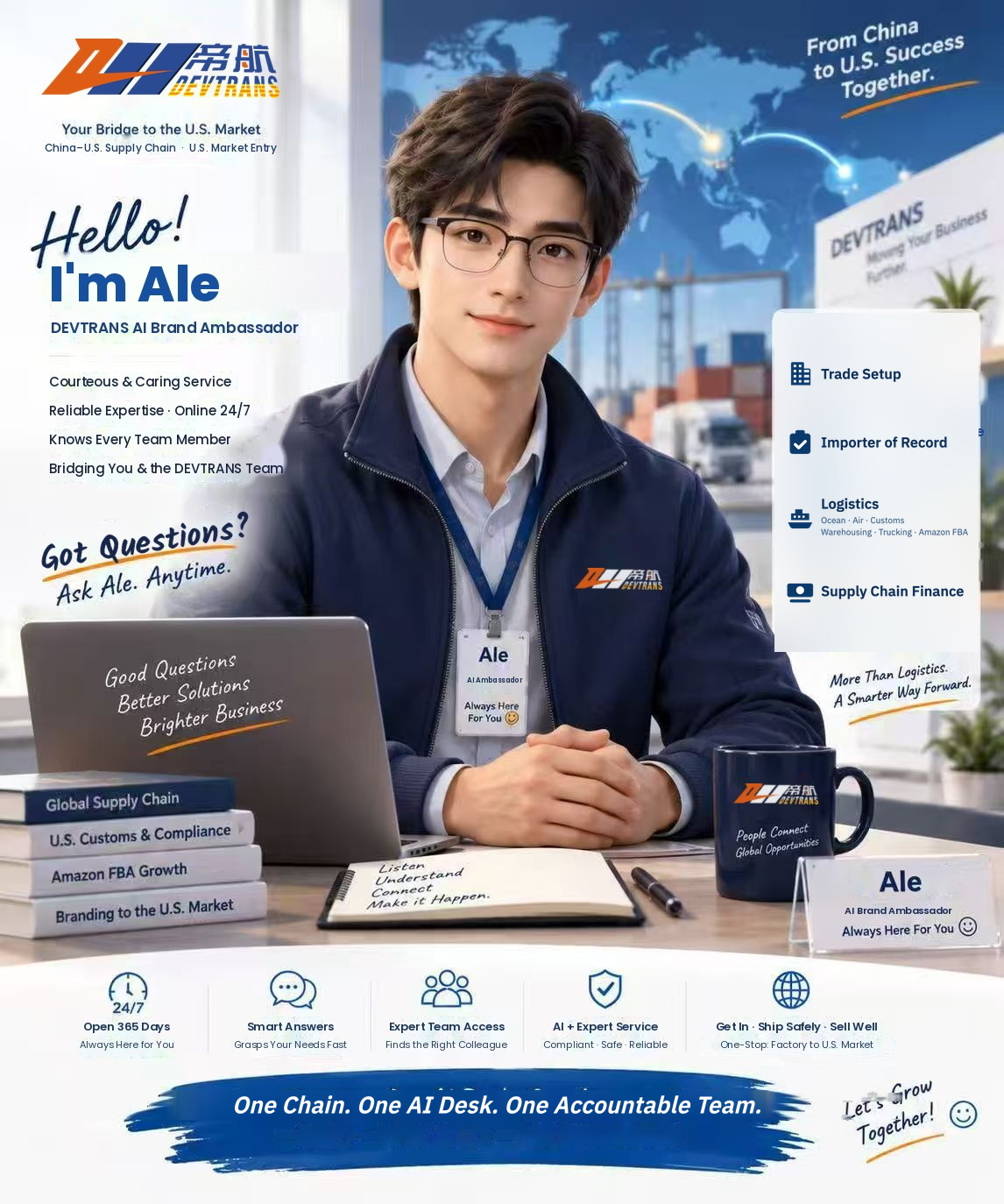
Your AI-powered China–U.S. supply chain desk — trade setup, importer of record, logistics and supply chain finance, the whole chain in one place.

From standing up a US entity and standing as importer, through ocean, clearance, warehouse and truck, to the cash cycle — I can walk you through what Devtrans does at each link and what you need to have ready.
Start with where you are: do you have a US entity, how will the goods enter, is it just freight you need or the whole chain? Tell me that and I can say what is blocking you and what comes next.
This one is still being assembled. A case needs the customer's written consent before it can be published, and so does a partner's name — so I will not pad this out with anything unverified.
Under two minutes on who you are talking to and what he can take off your hands. Watch it first and your questions get a lot more specific.
From standing up a US entity to goods on the shelf to the cash cycle — the whole chain in one place
About us →A US entity that can receive goods, invoice and file taxes
Turning a Chinese factory or seller into an operating entity that can sign, receive and reconcile inside the US market. Until this is in place, none of the next three stages can begin.
A real buyer making a real import
US Customs requires every shipment to have an Importer of Record, answerable for the accuracy of the declaration, the duty owed and compliance. Devtrans handles this as ordinary trade: our US entity buys the goods as a merchant and then imports them in its own name. The importer-of-record position follows from that trade rather than being a qualification lent out on its own.
Six directions out; the China–US lane run in house
Booking, trucking, export declaration, ocean and air, US clearance and final mile, overseas warehousing and direct fulfilment. Out of China we run to North America, South America, Europe, Southeast Asia, West Asia and Africa; on the non-US lanes we take on the transport itself, with a local agent at the destination end. This has been Devtrans' backbone since 2005, and the China–US lane is the one stage of the four run entirely by our own teams.
Products: US Dedicated Freight Line、Amazon FBA First-Leg Freight、US Overseas Warehouse、US-to-Mexico DDP (FCL & LCL)
While the goods move, the money cannot stall
On a cross-border chain, money goes out two or three months before it comes back. Devtrans offers supply chain finance to bridge that gap. The arrangement itself is worked out case by case with our commercial team, offline.
Three questions every China–U.S. shipment runs into. Three specialists who own them.
HTS classification · duty rates · declaration wording · documents · clearance.
The calls that carry liability if they are wrong. Clearance makes them, and puts the reasoning in writing.
IOR standing · counterparty risk · supply-chain continuity · inspection exposure.
Who the importer liability lands on depends on how the shipment is structured. Xiao An reads it before U.S. Customs does and sets out the risk.
Market positioning · channel · Amazon · brand · permitted claims.
Landing the goods is the easy part. Getting a brand into North America is a different discipline.
This chain is normally assembled one vendor at a time — trade, import, freight, financing — and nobody owns the seams between them. We hold all four, and we start before the booking: AI reads the shipment, the specialists rule on it, and our own teams execute.
Commodity, volume, origin port, destination warehouse, target arrival.
Restricted goods, packaging, labelling, certification gaps.
Classification, duty exposure, IOR standing, declaration wording.
Line, sailing, space and the appointment — quoted and confirmed by a person.
AMS and ISF filed in house, clearance and delivery by our own LA and NY teams.
Channel, positioning and the claims you are allowed to make.
Anyone can book a container. The difference is knowing what will go wrong before it does — and having your own people at the other end to fix it.
Four origin ports, six destination regions. China–US is the main lane and we run it end to end; elsewhere we move the freight.
All codes & zones →Every answer carries its source, its date, and a human you can escalate to
All rules →“How do I verify my IOR?”
“Which HTS code should I use?”
“What happens if CBP flags an importer?”
“How does DDP change under stricter U.S. compliance?”
New entries published every month. Also answered, with a page of its own:
Not sure what you need yet? Ask Ale. Got cargo, dates and a destination? Start a shipment.